
Why Does Chime Say “Card Declined by Issuer”?
Seeing a Chime Card Declined by Issuer message can be frustrating, especially if you have enough money in your account and your card appears to be working normally. Whether you’re making a purchase in a store, shopping online, or trying to pay a recurring bill, an issuer decline usually means the transaction wasn’t approved before it could be completed.
A Chime Card Declined by Issuer notification doesn’t always mean your card is damaged or your account has a serious problem. In many cases, the decline is triggered by insufficient available funds, temporary security checks, disabled card settings, incorrect payment information, merchant-related issues, or other authorization problems. Identifying the exact cause is the key to getting your card working again.
Understanding why a Chime Card Declined by Issuer message appears helps you avoid unnecessary troubleshooting and resolve the problem much faster. Instead of repeatedly attempting the same payment, it’s better to review your account and determine why the transaction wasn’t approved.
In this guide, you’ll learn why the Chime Card Declined by Issuer message appears, what it means, and the most effective ways to fix the issue.
Quick Answer
If you receive a Chime Card Declined by Issuer message, first check your available balance, confirm your card is active, verify that card transactions are enabled, review your payment information, and look for any account notifications. If everything appears correct, contact Chime Support or the merchant for additional assistance.
Table of Contents
Why Does Chime Say “Card Declined by Issuer”?
Short Answer: A Chime Card Declined by Issuer message usually means the transaction wasn’t approved because of insufficient available funds, security checks, disabled card settings, incorrect payment information, or another authorization issue.
The issuer reviews each transaction before deciding whether to approve or decline it. If something doesn’t meet the approval requirements, the payment may be rejected even if your card is active. Most issuer declines can be resolved by identifying and correcting the underlying cause.
What Does “Card Declined by Issuer” Mean?
Short Answer: A Chime Card Declined by Issuer notification means the payment request wasn’t authorized, preventing the transaction from being completed.
This message doesn’t always indicate a permanent problem with your Chime account. Instead, it signals that the transaction couldn’t be approved under the current conditions. The reason may be related to your account, the payment request, merchant processing, or a temporary security review. Reviewing your account information is usually the fastest way to identify the cause.
Before You Try the Payment Again
Before attempting another purchase, review your account carefully. Confirm that your available balance is enough to cover the full transaction, including any temporary authorization holds. Verify that your Chime card is active, ensure card transactions are enabled in the app, and check for recent account notifications or security alerts.
Taking a few minutes to review these details often explains why a Chime Card Declined by Issuer message appears.
Ways to Fix the Error
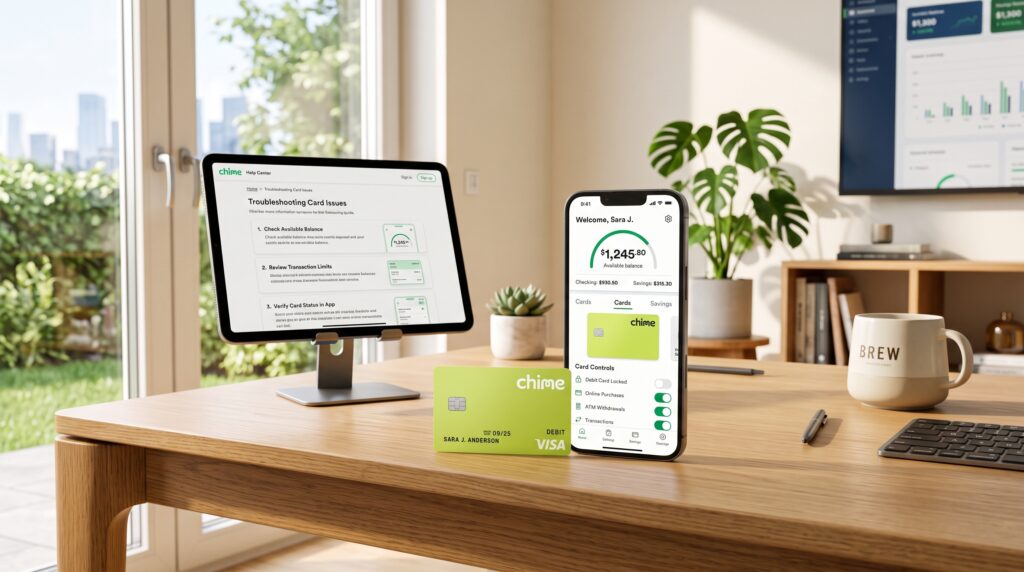
Fix 1: Check Your Available Balance
The first step is confirming your available balance. Even if money recently arrived in your account, pending transactions or authorization holds may temporarily reduce the amount available to spend. Review your available balance in the Chime app before trying the payment again.
Insufficient available funds remain one of the most common reasons for a Chime Card Declined by Issuer message.
Fix 2: Verify Your Card Is Active
Make sure your Chime debit card has been activated successfully. If you’ve recently received a replacement card or activated a new one, confirm you’re using the correct card and that activation has been completed. An inactive or outdated card may not be approved for purchases. Verifying your card status is another simple way to resolve a Chime Card Declined by Issuer issue.
Fix 3: Confirm Card Transactions Are Enabled
Chime allows users to manage debit card settings directly from the app. Check that card transactions haven’t been disabled accidentally. If purchases are turned off, enable them and retry your payment after saving the changes. Many users solve a Chime Card Declined by Issuer problem simply by restoring their card transaction settings.
Comparison Table
| Fix | Best For |
|---|---|
| Check available balance | Insufficient available funds |
| Verify card activation | New or replacement cards |
| Enable card transactions | Disabled debit card settings |
These first three fixes resolve many Chime Card Declined by Issuer errors. In the next section, we’ll cover additional troubleshooting methods, explain why payments sometimes continue to fail, and share practical tips that many Chime users overlook.
More Ways to Resolve the Decline
Fix 4: Verify the Payment Information
Incorrect payment details can cause an issuer decline even if your account is in good standing. If you’re shopping online, double-check your card number, expiration date, CVV, billing ZIP code, and cardholder name. A simple typing error may prevent the merchant from obtaining payment authorization. Reviewing your payment information is an easy way to fix a Chime Card Declined by Issuer error.
Fix 5: Check for Temporary Security Holds
Financial institutions sometimes place temporary holds on transactions that appear unusual. A large purchase, an international payment, or spending at a new merchant may trigger additional security checks. While these measures help protect your account, they can also result in a Chime Card Declined by Issuer message until the transaction is reviewed or verified. Checking your account notifications can help determine whether a security review is affecting your payment.
Fix 6: Review Your Recent Transactions
Looking through your recent transaction history may reveal the cause of the decline. Pending authorizations, duplicate purchases, or recently declined transactions can provide useful clues. Your transaction history may also help you identify unexpected activity that requires attention. Reviewing recent activity is an effective troubleshooting step for a Chime Card Declined by Issuer issue.
Fix 7: Try the Payment Again Later
Sometimes the problem is temporary. Merchant payment systems, banking networks, or authorization services may experience short-term interruptions. Waiting a few minutes before trying again can resolve a temporary Chime Card Declined by Issuer error without any additional action. If the payment continues to fail, move on to the remaining troubleshooting steps.
Fix 8: Contact the Merchant
The issue may not always originate with your Chime account. Ask the merchant whether their payment terminal or online checkout is experiencing problems. In some cases, the transaction wasn’t submitted correctly, or the merchant’s payment processor encountered an error. Confirming the merchant’s system is working properly helps rule out another possible cause of a Chime Card Declined by Issuer notification.
Fix 9: Contact Chime Support
If you’ve completed every troubleshooting step and your transactions continue to be declined, contact Chime Support. Explain when the decline occurs, where you’re attempting to use the card, and whether you’ve received any additional error messages. This information allows the support team to investigate your account more efficiently. Contacting Support is often the best solution for a persistent Chime Card Declined by Issuer problem.
Why the Card Is Still Being Declined
Short Answer: A Chime Card Declined by Issuer message may continue because your available balance is too low, your payment information is incorrect, a security review is in progress, the merchant is experiencing processing issues, or another authorization problem still exists.
Working through each possible cause one by one is usually the fastest way to identify the reason for the decline.
Common Problems
Users receiving a Chime Card Declined by Issuer notification often experience one or more of these issues:
- Insufficient available balance.
- Card transactions disabled.
- Incorrect payment details.
- Temporary security review.
- Merchant payment system issue.
- Pending authorization hold.
- Recently replaced debit card.
- Network processing delay.
- Temporary account notification.
Checking each possibility helps narrow down the exact reason your payment wasn’t approved.
What Most Chime Users Overlook
One of the biggest misconceptions about a Chime Card Declined by Issuer message is assuming that having money in the account guarantees every purchase will be approved. In reality, available balance, merchant authorization, payment information, and security checks all play a role in whether a transaction succeeds. Many users also overlook pending authorization holds, which can temporarily reduce their available balance even though the account appears to contain enough money.
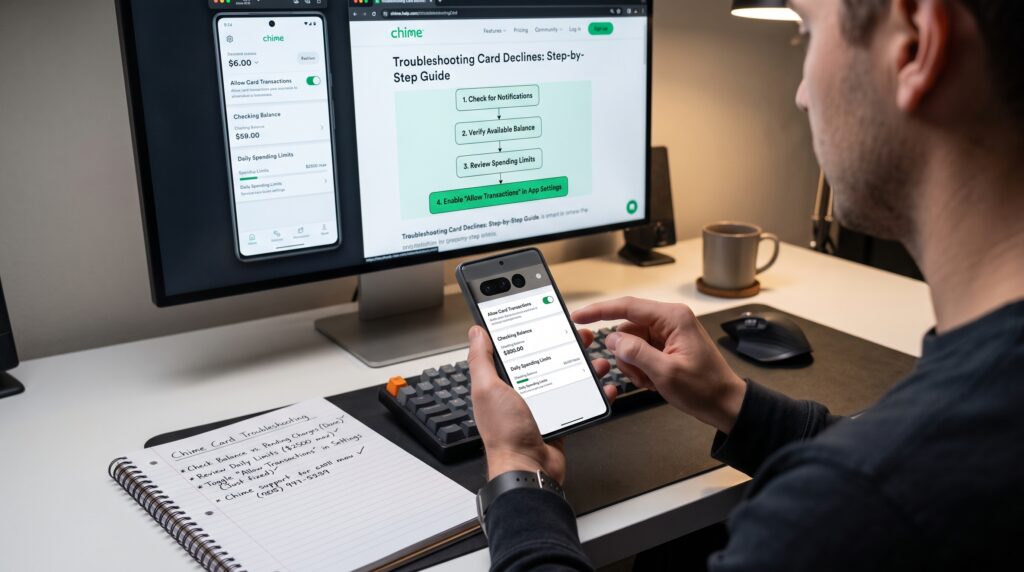
Comparison Table
| Problem | Recommended Solution |
|---|---|
| Low available balance | Add funds or wait for pending transactions |
| Card transactions disabled | Enable transactions in the Chime app |
| Incorrect payment details | Verify card information |
| Security review | Check account notifications |
| Merchant issue | Contact the merchant |
| Problem continues | Contact Chime Support |
These nine fixes resolve many Chime Card Declined by Issuer errors. In the final section, we’ll answer frequently asked questions, explain how to avoid future issuer declines, discuss when the merchant may be responsible, and summarize the most important takeaways.
Understanding Why Issuer Declines Happen
Not Every Decline Means Your Card Is Broken
Receiving a Chime Card Declined by Issuer message can make it seem like your debit card has stopped working, but that’s rarely the case. An issuer decline simply means the transaction wasn’t approved at that moment. The decision is based on several factors, including your available balance, account status, card settings, transaction details, and the information submitted by the merchant.
For example, if a merchant requests a temporary authorization amount that’s higher than your available balance, the payment may be declined even though the final purchase price would have been lower. Likewise, if your card information doesn’t exactly match the billing information entered during an online purchase, the issuer may reject the transaction to help protect your account.
Understanding that an issuer decline is often temporary helps you focus on identifying the cause instead of assuming your card needs to be replaced.
Pending Transactions Can Affect New Purchases
Many users overlook pending transactions when troubleshooting a Chime Card Declined by Issuer error. Whenever you make a purchase, some merchants place a temporary authorization hold before the payment fully settles. During this period, those funds are unavailable for other purchases, reducing your available balance.
Hotels, gas stations, car rental companies, and some restaurants commonly place larger authorization holds than the final purchase amount. Even though the extra funds are eventually released, the temporary hold can cause another transaction to be declined if your remaining available balance isn’t sufficient.
Checking your pending transactions before attempting another purchase can quickly explain why an unexpected decline occurred.
Good Habits That Help Prevent Future Declines
Keep Your Account Ready for Everyday Payments
Preventing a Chime Card Declined by Issuer message is often easier than fixing one. Regularly monitor your available balance instead of relying solely on your current balance, since pending authorizations may temporarily reduce the amount you can spend. It’s also a good idea to keep your debit card information updated for recurring subscriptions and online merchants, especially after receiving a replacement card.
Before making larger purchases, review your recent transactions and ensure your card settings are enabled within the Chime app. Taking these small precautions helps reduce unexpected declines and makes everyday payments much smoother.
Know When to Ask for Help
If you’ve checked your balance, confirmed your card information, reviewed pending transactions, and verified that the merchant isn’t experiencing payment issues, but your Chime Card Declined by Issuer message continues to appear, it’s time to seek assistance. Contacting Chime Support with details about the failed transaction—including the merchant, purchase amount, and time of the decline—can help the support team investigate more efficiently.
Providing accurate information allows them to determine whether the issue is related to your account, the payment network, or another authorization problem. Acting promptly can shorten the troubleshooting process and help restore normal card usage more quickly.
How to Avoid Future Card Declines
The best way to reduce future Chime Card Declined by Issuer errors is to keep enough available funds in your account, monitor pending transactions, and ensure your debit card information is always current. If you receive a replacement card, activate it immediately and update any recurring payments that still use the old card details. Regularly checking your Chime app for notifications can also help you identify account issues before they interrupt a payment.
When the Merchant Is the Problem
Sometimes the Chime Card Declined by Issuer message is triggered by the merchant rather than your account. Payment terminals can experience temporary outages, online checkout systems may fail to communicate with payment processors, or a merchant’s authorization request may not be submitted correctly. If your card works elsewhere but continues to fail at one specific business, asking the merchant to retry the transaction or use a different payment terminal may resolve the issue.
What to Check Before Trying Again
Before attempting another purchase, take a moment to confirm your available balance, review any pending transactions, verify your card information, and check the Chime app for account alerts. Completing these quick checks often identifies the reason for a Chime Card Declined by Issuer notification and prevents repeated failed transactions.

Frequently Asked Questions
Can a Chime card be declined even with money available?
Yes. A Chime Card Declined by Issuer message can appear even if your account has funds available. Pending authorization holds, disabled card settings, merchant processing issues, security reviews, or incorrect payment information may all prevent a transaction from being approved.
Why does my card work at some stores but not others?
Different merchants use different payment systems and authorization methods. A Chime Card Declined by Issuer error may occur at one business but not another if the merchant experiences payment processing problems or if the transaction triggers additional security checks.
Does an issuer decline mean my card is blocked?
Not necessarily. An issuer decline usually applies to a specific transaction rather than your entire account. Reviewing your account notifications and recent transactions can help determine whether any restrictions or security checks are affecting your card.
Should I try the payment again?
If the decline appears to be caused by a temporary issue, waiting a few minutes before trying again may help. However, if the same Chime Card Declined by Issuer message continues to appear, review your account instead of repeatedly submitting the transaction.
When should I contact Chime Support?
If you’ve confirmed your available balance, verified your payment information, enabled card transactions, and ruled out merchant issues but your card continues to be declined, contacting Chime Support is the best next step.
Can pending transactions affect my available balance?
Yes. Pending authorizations may temporarily reduce your available balance, even though the money hasn’t been fully deducted yet. This is one reason a Chime Card Declined by Issuer notification can appear unexpectedly.
Final Thoughts
A Chime Card Declined by Issuer message doesn’t always indicate a serious account problem. In many cases, the decline is caused by temporary authorization issues, insufficient available funds, security checks, incorrect payment information, or merchant-related problems. Identifying the underlying cause is usually much more effective than repeatedly attempting the same transaction.
If you’ve verified your account, confirmed your payment details, and ruled out merchant issues but your card still isn’t working, contacting Chime Support is the next logical step. Their team can review your account and help determine whether additional action is required.
Understanding why a Chime Card Declined by Issuer error appears allows you to troubleshoot the problem quickly, avoid unnecessary frustration, and restore successful payments with confidence.
Key Takeaways
- Chime Card Declined by Issuer errors can occur for several different reasons.
- Always check your available balance before retrying a payment.
- Verify your card is active and card transactions are enabled.
- Review your payment information for mistakes.
- Check for pending authorizations and account notifications.
- Merchant payment issues can also trigger issuer declines.
- Contact Chime Support if the problem continues after completing all troubleshooting steps.
End of Part 3.
Leave a Reply